
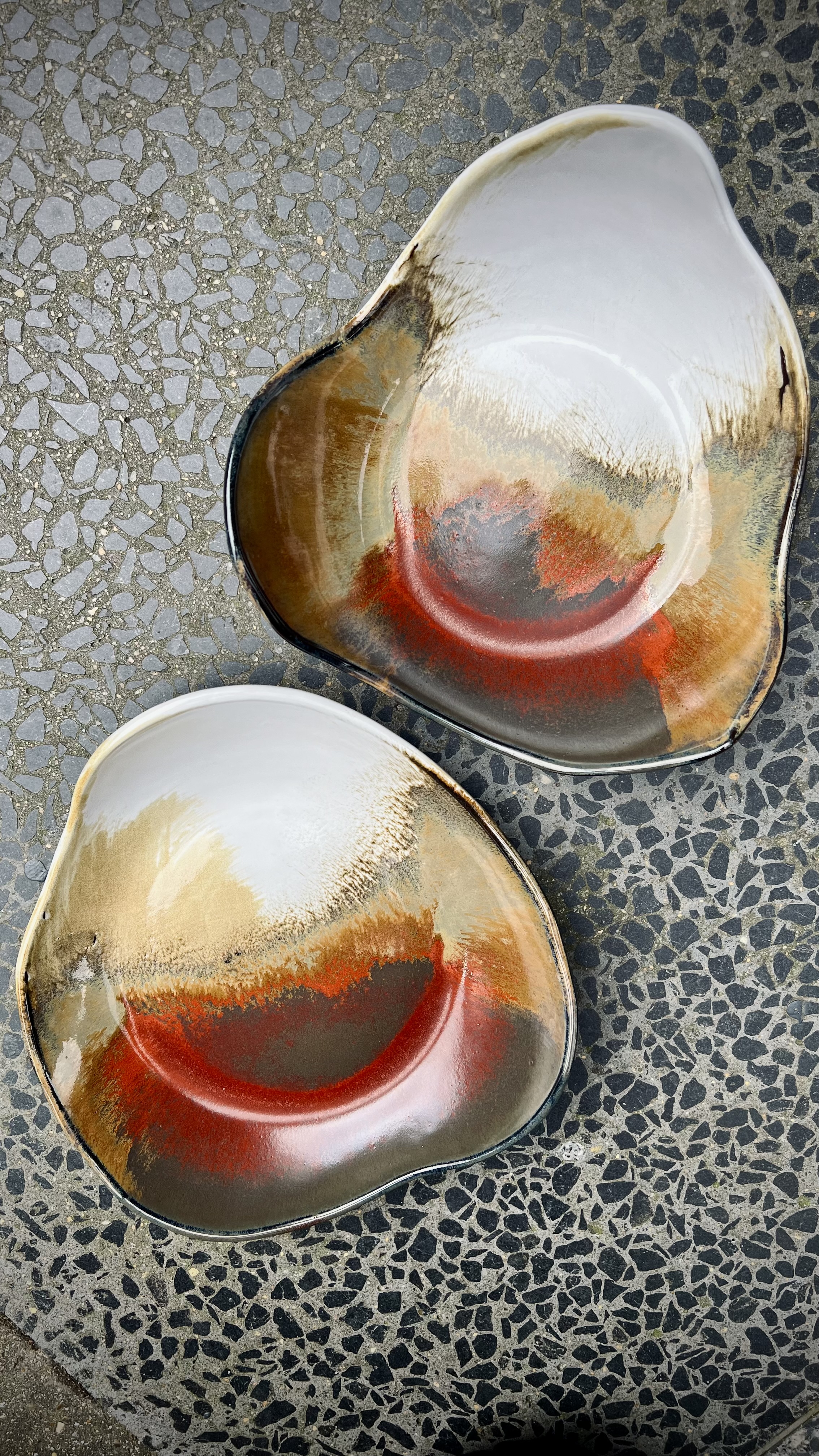
Throwing Against the Grain: Ehlers-Danlos Syndrome and the Making of an Accessible Ceramics Practice
Introducing the Artist
I'm Charlotte Collier-Hunter, founder of Preaface Ceramics, and I make functional and sculptural work from a body that was, quite literally, built softer than most. I have Ehlers-Danlos Syndrome (Ehlers-Danlos Syndrome), a connective tissue disorder that shapes almost every decision I make at the wheel, from how I open clay to how long I can spend making before my joints tell me to stop.
I spent twenty years as a registered nurse as a surgical assistant to orthopaedic surgeons before I came to clay. I understand the biology of my own body probably better than most people, and I want to use that understanding to explain something I think gets glossed over in most conversations about "disabled artists": EDS isn't a vague obstacle I work around through willpower. It has a mechanism. And once you understand the mechanism, adaptive practice stops looking like a compromise and starts looking like good engineering.
What Ehlers-Danlos Syndrome Actually Does to Connective Tissue
EDS is a family of genetic connective tissue disorders, and most people who have it fall into one of two main types: hypermobile EDS (hEDS) and classical EDS (cEDS). Both are rooted in how collagen, the structural protein that gives skin, tendons, ligaments and joint capsules their strength is built and organised.
A 2022 mechanobiology review in Frontiers in Cell and Developmental Biology lays out the physical story clearly. In EDS, collagen fibrils form irregularly and, counter to what you might expect from thicker fibres, the resulting tissue is measurably softer and less elastic than typical connective tissue, particularly under small, everyday loads rather than extreme ones. That softness isn't a metaphor, it's a mechanical property that's been measured directly in skin and tendon studies. It's why joints move further than they should (hypermobility and instability), why skin can be stretchier and more fragile, and why so many of us describe our bodies as "unreliable" under repetitive strain rather than dramatic injury.
Two comorbidities the review focuses on are especially relevant to a working potter's life:
- Mast Cell Activation Syndrome (MCAS), found in roughly a quarter of people with hypermobile EDS. The review's central idea is that mast cells, the immune cells responsible for releasing histamine, partly sense their environment mechanically. In a softer extracellular matrix, mast cells may be less stable and more prone to releasing their contents in response to ordinary physical stimuli like vibration or friction, not just classic allergens. For a potter, that means the vibration of a wheel, repetitive throwing motion, or friction against tools isn't just tiring, it may be a literal physiological trigger.
- Impaired wound healing, means reduced stiffness in the extracellular matrix appears to slow the processes by which skin cells migrate into a wound and remodel it, meaning cuts, cracked knuckles, and the small nicks that are an occupational hazard of clay work take longer to close and scar differently.
None of this is designed to alarm anyone or to stand in for medical advice, it's simply the biology behind why a body like mine asks for a different relationship with repetitive, high-friction, high-vibration work than a textbook pottery studio was ever built around.
Why Adaptive Studio Practice Isn't a Downgrade
Traditional studio pottery evolved around a fairly narrow assumption: a body that can wedge, centre, and throw for hours without joint instability, without unpredictable fatigue, and without skin that splits under normal pressure. That assumption was never universal, and it certainly isn't mine.
The adaptations I've built into my practice in my studio aren't shortcuts, they're direct responses to the mechanics described above:
- Reducing repetitive strain at the wheel. Because joint instability and connective tissue laxity mean my hands and wrists absorb more shock than a typical potter's, tools and batt systems that reduce twisting, wiring, and repeated fine-motor gripping aren't a luxury, they're what keeps me working season to season instead of flaring out after a few weeks.
- Managing vibration exposure. Given the mechanobiological link between vibration and mast cell degranulation in hEDS, I pace throwing sessions and hand build in recovery time the way an athlete would, rather than pushing through a full studio day and paying for it later.
- Protecting skin integrity. Because wound healing is slower and scarring can be more pronounced, I treat small cuts and cracked skin as something to manage proactively. Using barrier creams, gloves, and studio hygiene aren't fussiness, they're prevention.
- Ergonomic layout over "proper" technique. There is no single correct way to centre clay, wedge a body, or set up a bench. There's only the way that lets a particular set of joints, ligaments, and energy levels do the work sustainably. I have designed my studio around that principle rather than around tradition for its own sake.
This is the same argument I made last year in a piece for Hartley & Noble, Art is Disobedience that pottery, like the rest of art, benefits from experimentation and adaptation rather than a single "proper" method. What's changed since then is that I've had more time to sit with the actual mechanobiology behind that instinct, and it's only strengthened the case.
What This Means for the Next Stage of Preaface Ceramics
Understanding the mechanics of my own condition has shaped more than just how I throw, it's shaping where Preaface Ceramics is headed next. A lot of people leaving open community studios and buying their first kiln are never taught the physical, repetitive motion realities of loading and firing one: the bending, the lifting, the fine judgement calls around heat work and cone placement that can be done efficiently or done in a way that wears a body down.
I'm developing one-on-one kiln-loading tutoring for people in exactly that position, built around the same principle that runs through everything else here, that there's a sustainable, ergonomically sound way to do this work, and it's worth teaching properly from day one rather than letting people self-injure their way to competence. Details on that are coming soon; if you're newly kiln-owning and want to be among the first to know, get in touch.
Frequently Asked Questions
Is Ehlers-Danlos Syndrome common among ceramic artists?
There's no formal data on prevalence within the ceramics community specifically, but pottery's repetitive, high-friction, joint-intensive nature means it intersects heavily with the kinds of strain hypermobile and classical EDS make harder to tolerate, which is part of why accessible studio design matters so much in this craft.
Can someone with EDS or joint hypermobility safely learn pottery?
Many people with EDS and related hypermobility spectrum disorders do work in clay successfully, usually by adapting tools, pacing, and studio layout to their own joints rather than following a one-size-fits-all technique. This isn't medical advice, and anyone managing a connective tissue disorder should work from guidance suited to their own diagnosis and symptoms — but craft adaptation itself is well precedented.
What is mast cell activation syndrome, and how does it relate to pottery?
MCAS is a condition in which mast cells (immune cells that release histamine) become unusually easy to trigger, including via physical stimuli like vibration and friction, not just allergens. Around a quarter of people with hypermobile EDS have it, which is relevant to any repetitive, vibration-heavy craft practice like throwing on a wheel.
Who is Charlotte Collier-Hunter?
Charlotte Collier-Hunter is a London-based ceramic artist and the founder of Preaface Ceramics, making handcrafted functional and sculptural work. She spent twenty years as a registered nurse before retraining in ceramics, and she writes and advocates on disability, neurodivergence, and accessibility within the craft world as a disabled, AuDHD potter living with Ehlers-Danlos Syndrome.
Charlotte Collier-Hunter is the founder of Preaface Ceramics, a London based ceramics practice specialising in handcrafted functional and sculptural work. A former registered nurse of two decades, she writes and speaks on disability, neurodivergence, and accessibility in the craft world.